
High-trust software needs more than feature delivery
On a live public memorial platform, accessibility, regression prevention, team capacity, and stakeholder trust were all parts of the same delivery responsibility.
< 2 months
Administrative platform delivery
The team delivered the administrative platform while continuing to support the live public experience.
50%
Regression reduction
Regression volume fell by half during the first three months of the engagement.
2 → 4
Engineering capacity
I helped rebuild and grow the Keeper engineering team from two to four contributors.
Recognized
VLM VA Director recognition
The VLM VA Director presented a ceremonial coin and publicly praised my leadership and accomplishments on the platform.
The real situation
The Veterans Legacy Memorial helps preserve service histories, photographs, documents, and family-contributed memories. That changes what good software delivery means. Accessibility is not merely compliance, reliability is not merely uptime, and a regression can affect how a family experiences someone they never want forgotten.
I joined after a lead transition with a small team, an evolving architecture, extensive government onboarding, and a live public platform that still needed to move forward. The work required technical direction, hands-on frontend delivery, team rebuilding, quality improvement, and calm coordination across organizational boundaries.
What the business was carrying
The visible problem
- The previous lead had departed, leaving a small team with limited tenure on the platform.
- The architecture and frontend patterns were still evolving while public delivery continued.
- Section 508 accessibility, careful data handling, and emotionally significant content raised the cost of careless change.
Why the obvious fix was not enough
The harder system underneath
- I had to learn the platform and complete government onboarding while helping another engineer ramp up.
- Technical decisions needed to balance consistency, simplicity, accessibility, and the constraints of an established live codebase.
- Trust had to be rebuilt among engineers, product, design, government stakeholders, and partner teams.
The trust system
Reliability, accessibility, people, and delivery reinforced one another
The platform could not be treated as a collection of isolated tickets. Public trust depended on the experience, the engineering practices, and the team’s ability to work together.
Before
- Live emotionally significant platform
- Small team after a lead transition
- Evolving architecture
- Accessibility and quality risk
After
- Administrative platform delivered in under two months
- Regression volume reduced by half
- Team grew from two to four
- Formal stakeholder recognition
- 01
Context
Learn the platform and public-service constraints
Understand where technical and organizational responsibilities lived.
- 02
Quality
Strengthen accessibility and regression prevention
Make Section 508 and testing part of normal delivery.
- 03
Capacity
Rebuild a cohesive engineering team
Use pairing, coaching, and shared ownership to restore confidence.
- 04
Delivery
Add administrative capabilities carefully
Improve internal management without neglecting the public experience.
What changed
Decisions that moved the work forward
- 1 Learn
Understand the system and its responsibility
I mapped the architecture, frontend patterns, government processes, and cross-team dependencies before treating any existing choice as obviously right or wrong.
- 2 Strengthen
Make quality and accessibility everyday work
I supported Section 508 improvements, clarified testing expectations, surfaced risk earlier, and encouraged reusable frontend patterns.
- 3 Rebuild
Grow team capacity through shared work
Pairing, mob sessions, 1:1s, planning, retrospectives, and patient technical collaboration helped a small team become more cohesive and confident.
- 4 Deliver
Support the public platform while adding administration
My team delivered new administrative capabilities in under two months while continuing to maintain the live memorial experience.
What the business gained
Results beyond the implementation
01
The team gained capacity and a calmer, more collaborative delivery rhythm.
02
Accessibility and regression prevention were treated as product responsibilities rather than release cleanup.
03
Stakeholders received administrative capabilities while the public platform remained supported.
What this proves for a client
The scale may change. The systems judgment still transfers.
High-trust work is not a special category of coding. It is a way of making decisions: understand the human consequences, keep risk visible, design for accessibility, make maintenance possible, and communicate clearly enough that people can trust both the system and the team behind it.
Technical footprint
Evidence and boundaries
- ✓ Administrative platform delivered in under two months
- ✓ 50% regression reduction in first three months
- ✓ Team growth from two to four
- ✓ Section 508 accessibility work
- ✓ Recognition from the VLM VA Director
Government-sensitive implementation details, protected data, internal personnel matters, and private stakeholder discussions remain excluded.
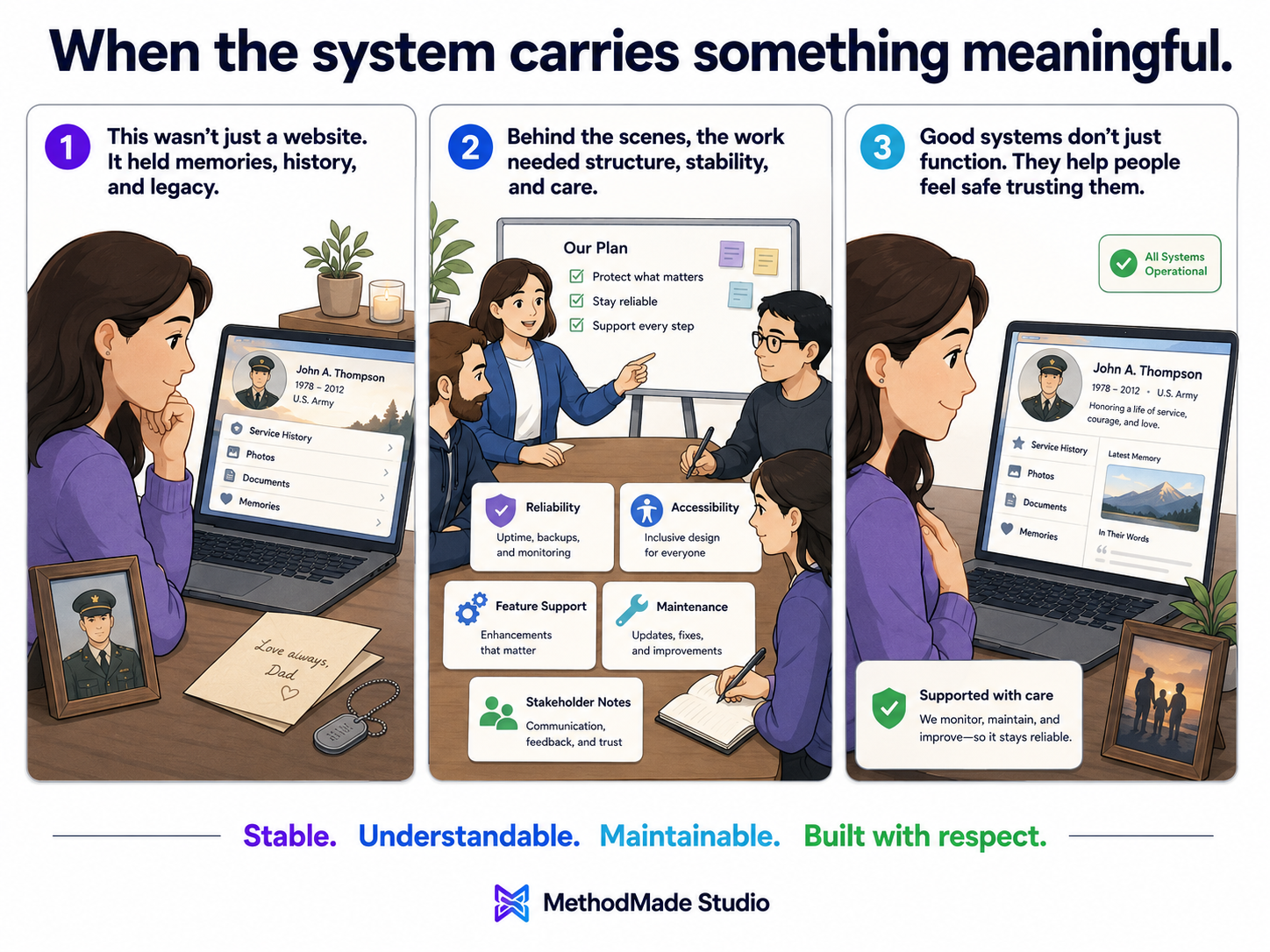
Visual recap
The work behind a system people trust.
Related practical guide
When a Project Has Emotional Stakes
Read the guide →Related experience
Browse the full proof library for other systems, workflow, and delivery examples.
A practical next step
Protect trust while the system changes
For sensitive, public-facing, or inherited platforms, a technical review can make accessibility, reliability, and delivery risk visible before the next change.